4 Fitness Tests That May Predict Your Independence as You Age
A major study involving more than 4,500 adults found that a few simple physical measurements may provide valuable clues about your ability to remain independent as you age.
Most people want to live long, healthy lives. But there’s an important difference between living longer and maintaining the physical ability to enjoy those additional years.
Think about the everyday activities you probably take for granted.
Getting out of a chair. Walking through the grocery store. Climbing stairs. Maintaining your balance when you stumble. Getting out of bed without assistance.
These movements may seem insignificant today, but they play an important role in determining whether we can continue living independently as we get older.
A 2026 study published in GeroScience, using data from the long-running Whitehall II Study, examined whether simple physical measurements could help predict who would experience difficulty performing everyday activities more than a decade later.
The results offer valuable insights into how we should approach exercise as we age.
What Did the Researchers Study?
The Whitehall II Study began in 1985, initially following more than 10,000 British civil servants to investigate how different factors influence long-term health.
For this particular analysis, researchers examined 4,593 adults with an average age of 65.3 years, using physical assessments collected between 2007 and 2009.
Participants were followed for approximately 11 years to determine whether they developed difficulty performing basic activities of daily living.
These activities included:
- Bathing
- Dressing
- Feeding themselves
- Walking
- Getting into bed
- Using the toilet
Researchers classified participants as having developed a disability if they reported difficulty with at least one of these activities. Severe disability meant difficulty with two or more.
What Happened Over the Next 11 Years?
Among the 4,593 participants:
- 828 people (18%) developed at least one disability.
- 377 people (8.2%) developed severe disability.
- 596 people (13%) died during follow-up.
The researchers wanted to understand which physical measurements taken years earlier were most useful for predicting these outcomes.
What they discovered was particularly interesting.
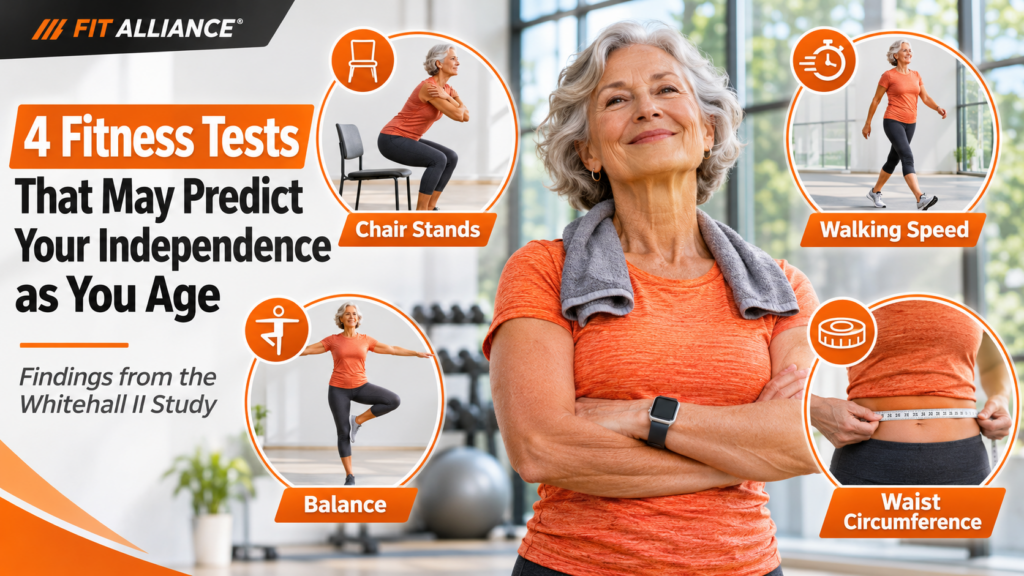
Four Physical Measurements Helped Predict Future Disability
Researchers examined 10 different measurements, including grip strength, walking speed, body mass index (BMI), waist circumference, standing balance, and chair-rise performance.
After analyzing the data, four measurements emerged as useful additions to age and sex for predicting future disability:
1. Getting Up From a Chair: A Simple Test of Lower-Body Function
One of the assessments measured how quickly participants could stand up from a chair five times without using their arms.
This might sound easy, but the movement requires several important physical abilities.
You need sufficient lower-body strength to lift your body weight, coordination to control the movement, and the ability to repeatedly produce force.
Now consider how many times you perform a similar movement throughout your day.
Standing up from the couch, getting out of the car, rising from the toilet, or getting up from the dinner table.
These are all activities that rely on your ability to produce enough muscular force to move your body.
The researchers found that poorer chair-rise performance was associated with an increased risk of future disability.
Why this matters for exercise
Building and maintaining lower-body strength should be an important part of any exercise program for older adults.
Exercises such as squats, leg presses, step-ups, split squats, and other progressive resistance exercises can help develop the muscles responsible for these everyday activities.
For someone who struggles to get out of a chair, the starting point might simply be practicing that movement with appropriate assistance.
For someone who already performs it easily, progressively increasing resistance can help challenge and improve their strength.
The important thing is to continue developing your physical capabilities rather than allowing them to gradually decline.
2. Walking Speed: More Than Just Getting From Point A to Point B
Another measurement involved walking a short distance at a normal, comfortable pace.
Researchers recorded participants’ walking speed over three trials of an eight-foot walk.
Slower walking speed was associated with a greater risk of future disability and contributed to the researchers’ final prediction model.
Why would walking speed tell us something about future independence?
Walking requires multiple systems to work together.
Your muscles must generate enough force to propel your body forward. Your nervous system coordinates your movements, while your cardiovascular system supports the activity.
You also need sufficient balance and stability to move confidently.
A decline in walking speed may reflect changes in one or more of these systems.
Why this matters for exercise
Walking regularly is beneficial, but it’s also important to maintain the physical abilities that make walking easier.
Resistance training helps develop lower-body strength. Cardiovascular exercise supports endurance. Balance and coordination exercises can improve movement confidence.
For adults who can safely perform them, exercises that emphasize producing force quickly may also help develop muscular power.
The goal isn’t necessarily to walk as fast as possible.
It’s to maintain the physical capacity to move comfortably and confidently through everyday life.
3. Balance: An Important Part of Maintaining Independence
Researchers also tested balance using progressively more challenging standing positions.
These included standing with the feet together and standing with one foot positioned directly in front of the other.
Poorer balance performance was associated with an increased risk of future disability.
This is especially relevant because maintaining balance becomes increasingly important as we age.
Consider what happens when you trip over a curb or lose your footing on an uneven surface.
Your nervous system must recognize the disturbance, and your muscles must respond quickly enough to help restore stability.
Balance involves coordination between your vision, inner ear, sensory systems, nervous system, and muscles.
Why this matters for exercise
Balance training should involve more than simply standing on one foot.
Depending on your current abilities, an appropriate program might include:
- Standing in progressively narrower positions
- Single-leg balance exercises
- Stepping in different directions
- Controlled changes of direction
- Exercises that challenge stability during movement
Lower-body strength and muscular power are also important components of maintaining stability and responding to unexpected movements.
At Fit Alliance, we incorporate balance challenges appropriate to each person’s abilities, progressively increasing difficulty as their capabilities improve.
4. Waist Circumference: The Strongest Individual Predictor
Perhaps the most surprising finding was that waist circumference was the strongest individual measurement for improving disability prediction beyond age and sex.
Researchers found that a one-standard-deviation increase in waist circumference was associated with a 34% higher hazard of developing disability during follow-up, after accounting for age and sex.
This is a statistical comparison rather than a specific increase in inches, and it does not establish that abdominal fat directly caused disability.
Waist circumference can be an indicator of abdominal fat accumulation, which is associated with several metabolic and cardiovascular health concerns.
However, it’s important to understand what the study does and doesn’t tell us.
It doesn’t mean that someone with a larger waist will necessarily become disabled or that reducing waist circumference guarantees independence.
It does suggest that body composition and metabolic health deserve attention alongside physical performance.
Why this matters for exercise
For adults over 50, the goal shouldn’t simply be losing weight.
Maintaining muscle mass while managing excess body fat may be a more useful approach to supporting long-term health and physical function.
Resistance training can help preserve or increase muscle mass, while appropriate nutrition and cardiovascular exercise can support overall health and body composition.
Focusing exclusively on the number on the scale can overlook some of the physical qualities that make everyday life easier.
What About Grip Strength?
Grip strength is commonly used in research as an indicator of general muscular strength and physical health.
The Whitehall II researchers measured grip strength and found that it was associated with future outcomes.
Interestingly, grip strength was not selected for their final disability prediction model, although it was included in the model examining mortality.
This doesn’t mean upper-body strength is unimportant.
It simply means that, when the researchers considered multiple measurements together, other factors provided more useful information for predicting disability.
This distinction reinforces an important point: no single physical test tells the complete story of someone’s functional abilities.
Can These Tests Really Predict Your Future?
While the findings are interesting, there are some important limitations.
The researchers found that combining these measurements improved their ability to predict disability, but the models were only moderately accurate.
The final prediction model achieved a statistical discrimination score of approximately 0.66 for disability and 0.70 for severe disability, on a scale where 0.5 represents chance and 1.0 represents perfect discrimination.
In other words, the measurements provided useful information, but they could not reliably determine whether a specific person would eventually develop a disability.
The researchers also found that predictions were less accurate among participants with musculoskeletal conditions, such as arthritis.
Additionally, this was an observational study.
The researchers did not test whether improving these measurements through exercise would directly reduce disability risk.
However, the results help identify physical qualities worth monitoring, and other exercise research supports the value of resistance training and balance training for improving physical function in older adults.
Why You Shouldn’t Wait Until You’re 70 to Start
One of the most important aspects of this research is the timing.
Participants were approximately 65 years old when their physical abilities were measured.
Those measurements helped predict who would experience disability over the following decade.
Think about what that means for someone currently in their 40s, 50s, or early 60s.
There’s an opportunity to begin developing and maintaining these physical abilities long before significant limitations appear.
Unfortunately, changes in physical function often happen gradually.
You may not notice that getting out of a chair requires more effort than it did five years ago.
You might begin avoiding certain activities because they feel more difficult.
You may find yourself using a handrail more frequently or becoming less confident walking on uneven surfaces.
These changes don’t necessarily mean you’re headed toward disability, but they may be signs that certain physical abilities deserve more attention.
And although aging affects everyone, we can take steps to improve many aspects of physical function.
Training for Independence: What Should You Focus On?
The findings from this study reinforce the importance of developing a broad range of physical abilities.
At Fit Alliance, we emphasize five important components of fitness for adults over 50.
- Muscular Strength
Building the ability to produce force helps support daily activities such as standing, lifting, carrying, and climbing stairs.
- Muscular Power
Strength is important, but so is the ability to produce force quickly.
Muscular power plays a role in activities such as rising from a chair efficiently, stepping quickly, and responding to an unexpected loss of balance.
- Balance and Coordination
Improving stability and movement control helps us navigate different environments more confidently.
- Cardiovascular Fitness
Maintaining cardiovascular endurance helps support activities such as walking, hiking, traveling, and remaining physically active throughout the day.
- Mobility
Having sufficient mobility allows us to move through the ranges of motion needed for comfortable and efficient daily activities.
These qualities work together, which is why a well-rounded exercise program should include more than just walking or lifting weights.
The specific exercises, intensity, and progression should reflect each person’s goals, abilities, and health considerations.
How Do You Know If You’re Improving?
One of the most useful lessons from this study is the value of measuring physical function.
At Fit Alliance, we believe progress should involve more than simply completing workouts.
Periodically assessing strength, balance, mobility, and other physical abilities can help identify improvements and areas that need additional attention.
For example, if someone requires 15 seconds to complete five chair stands and later improves to 11 seconds, that provides a measurable indication of better performance.
If someone can maintain a challenging balance position longer than they could three months earlier, that’s another indication of progress.
These changes shouldn’t be interpreted as a specific reduction in future disability risk based on this study, but they do provide meaningful information about improvements in physical function.
The goal is to help people recognize their progress and continue developing the abilities that support their everyday lives.
The Bottom Line: Independence Is Worth Training For
The Whitehall II research offers an important perspective on healthy aging.
Our ability to perform relatively simple physical tasks in our 60s may provide clues about the likelihood of experiencing limitations in our 70s and beyond.
And although these measurements cannot perfectly predict the future, they highlight physical abilities that are important to monitor and maintain.
You don’t need to wait until getting out of a chair becomes difficult to start building lower-body strength.
You don’t need to experience a fall before working on balance.
And you don’t need to notice a decline in your walking ability before improving your cardiovascular fitness.
The goal of exercise isn’t just to add years to your life. It’s to help maintain the physical abilities that allow you to enjoy those years.
Whether you want to continue traveling, hiking, gardening, playing with grandchildren, or simply living independently in your own home, your physical capabilities matter.
And investing in those abilities today may help prepare you for the years ahead.
Ready to Take the First Step?
At Fit Alliance, we specialize in helping adults 50+ improve their strength, balance, mobility, and overall physical fitness.
Whether you’re new to exercise, returning after an injury or surgery, or looking to continue challenging yourself, our individualized coaching meets you where you are.
We offer small group personal training and one-on-one coaching at our Tigard and Beaverton locations.
Schedule your FREE initial assessment to learn more about your current abilities and how we can help you work toward your goals.
Because maintaining your independence is something worth working toward at every age.
References
Ben Hassen, C., et al. (2026). Identifying a fitness tool in early old-age to predict long-term risk of disability, severe disability, and mortality. GeroScience.
Marmot, M., & Brunner, E. (2005). Cohort Profile: The Whitehall II Study. International Journal of Epidemiology, 34(2), 251–256.