Schroth Method for Scoliosis: How Physical Therapy and Strength Training Work Together
For individuals living with scoliosis, exercise can sometimes feel confusing. Questions like “Is this movement safe for me?”, “Why does my back, neck, shoulder, or hip hurt after certain exercises?”, or “Can I still lift weights?” are incredibly common.
The good news is that scoliosis doesn’t mean you have to stop exercising. In fact, resistance training can be one of the most valuable tools for improving strength, building muscle, supporting bone health, and increasing your ability to perform everyday activities. The key is understanding how to exercise for your body.
One of the most recognized and well-researched approaches to scoliosis-specific rehabilitation is the Schroth Method. When combined with an individualized strength and conditioning program, it provides a framework that can help people move with greater confidence while continuing to get stronger.
What Is the Schroth Method?
The Schroth Method is a specialized form of physical therapy for scoliosis that was developed in Germany over 100 years ago. Unlike general exercise programs, it recognizes that scoliosis is a three-dimensional deformity involving:
- Side-to-side curvature of the spine
- Rotation of the vertebrae and rib cage
- Changes in the spine’s normal front-to-back curves
Because every person’s scoliosis is different, no two Schroth programs are exactly alike. Treatment is individualized based on each person’s curve pattern, symptoms, posture, mobility, and functional goals.
The Core Principles of the Schroth Method
Although every program is customized, the Schroth Method is built around several important concepts.
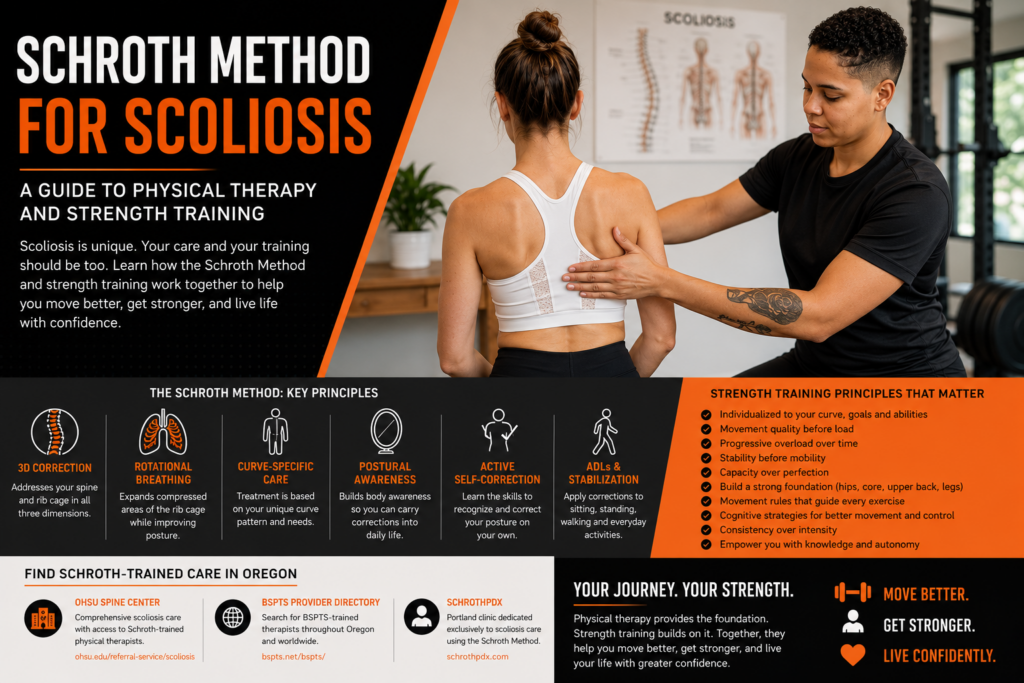
Three-Dimensional Correction
Rather than addressing only the visible sideways curve, Schroth works to improve alignment in all three dimensions of the spine and rib cage.
Curve Classification
One of the defining features of the Schroth Method is that treatment begins by identifying an individual’s specific curve pattern. This classification guides the corrective positions, breathing techniques, and exercises used throughout therapy. Instead of prescribing the same exercises for everyone with scoliosis, treatment is tailored to each person’s unique spinal alignment.
Spinal Elongation
Many Schroth exercises begin by encouraging length through the spine, helping reduce unnecessary compression while promoting improved posture and alignment.
Rotational Angular Breathing
One of the most distinctive aspects of the Schroth Method is its specialized breathing technique. Because scoliosis often creates areas of compression within the rib cage, breathing is used as an active component of treatment to encourage expansion of those areas while reinforcing improved posture.
Postural Awareness and Sensorimotor Training
A major goal of Schroth therapy is helping individuals develop greater awareness of their posture and movement patterns. Therapists use mirrors, tactile cues, and guided practice to improve body awareness and help patients recognize what balanced posture feels like.
Active Self-Correction
Rather than relying on a therapist to continually reposition the body, patients gradually learn to recognize and perform their own corrections independently. This promotes long-term confidence and self-management.
Stabilization
Achieving a corrected posture is only the first step. Schroth also emphasizes learning how to maintain that correction while breathing, moving, and performing everyday activities.
Activities of Daily Living (ADLs)
The Schroth Method extends beyond therapy sessions. Patients learn how to apply corrective principles while sitting, standing, walking, lifting, carrying objects, working at a desk, and performing other daily activities. The goal is to make healthier movement patterns part of everyday life.
Why Specialized Physical Therapy Matters
General exercise recommendations often aren’t enough for someone with scoliosis.
A physical therapist trained in scoliosis-specific care can evaluate your individual curve pattern, identify movement habits that may contribute to discomfort, and develop a personalized treatment plan designed specifically for your body.
This individualized approach helps build confidence, reduces fear of movement, and creates the foundation for long-term success with exercise.
Physical Therapy Resources in the Portland, Oregon Area
If you’re looking for Schroth-based care in Oregon, these are excellent places to begin:
- OHSU Spine Center
https://www.ohsu.edu/referral-service/scoliosis
Offers access to physical therapists trained in scoliosis management, including the Schroth Method, as part of a comprehensive multidisciplinary spine program. - BSPTS (Barcelona Scoliosis Physical Therapy School) Provider Directory
https://bspts.net/bspts/
Search for physical therapists who have completed advanced BSPTS Schroth training throughout Oregon and around the world. - SchrothPDX
https://schrothpdx.com/
A Portland-area clinic dedicated exclusively to scoliosis care using Schroth-based evaluation and treatment.
Finding a provider with specialized scoliosis training is one of the most important first steps in developing an effective long-term management plan.
Physical Therapy Is Only Part of the Picture
While scoliosis-specific physical therapy provides the corrective framework, many people also benefit from a structured strength and conditioning program.
The challenge is that many traditional exercise programs—or even well-intentioned personal trainers—may not understand how scoliosis changes movement mechanics. As a result, people often avoid exercise altogether or repeatedly perform movements that leave them sore, stiff, or discouraged.
This is where knowledgeable strength coaching can play an important role.
Where Fit Alliance Fits In
At Fit Alliance, we believe physical therapy and strength training should work together—not independently.
Our role is not to replace your physical therapist. Instead, we collaborate with them to help bridge the gap between rehabilitation and lifelong fitness.
We help clients integrate the principles they learn in physical therapy into a progressive strength training program that builds confidence, resilience, and independence.
This may include:
- Integrating your scoliosis-specific exercises into your overall strength program.
- Selecting exercise variations that fit your individual anatomy, mobility, and curve pattern.
- Identifying movements that may aggravate your specific spinal alignment.
- Developing personalized movement “rules” that help you move more efficiently and comfortably during workouts and daily activities.
- Teaching cognitive strategies such as muscle engagement patterns, breathing techniques, and body positioning that improve movement quality.
- Adjusting exercise tempo, range of motion, loading strategies, and exercise progression when appropriate.
- Building a progressive resistance training program that respects your individual needs while helping you become stronger over time.
Strength Training Principles That Matter for Scoliosis
Successful strength training isn’t about finding a list of “good” or “bad” exercises. It’s about applying sound training principles to the individual in front of you.
Some of the most important principles include:
Individualization
No two people with scoliosis move exactly the same. Exercise selection should reflect each person’s curve pattern, symptoms, mobility, stability, experience, and goals.
Movement Quality Before Load
Before adding weight, it’s important to learn how to perform movements with good control. As movement quality improves, exercises can be progressed appropriately.
Progressive Overload
People with scoliosis still need progressive overload to build strength, muscle, bone density, and long-term physical capacity. Progress may occur differently than it does for someone without scoliosis, but gradual progression remains essential.
Stability Before Mobility
Many people assume they need more stretching. In reality, some individuals benefit more from learning to control the movement they already have before pursuing additional mobility.
Capacity Over Perfection
The goal isn’t perfect posture. The goal is building a body that becomes stronger, more resilient, and better able to tolerate the demands of everyday life.
Movement Rules
Rather than memorizing hundreds of exercise-specific cues, we help clients develop a small set of foundational movement principles that guide nearly every exercise they perform. These individualized “movement rules” become tools they can apply throughout their fitness journey.
Autonomy
One of our primary goals is helping clients become increasingly independent. We want you to understand why you’re performing certain exercises, how to recognize quality movement, and how to modify your training as your body and abilities evolve.
The Long-Term Goal
Scoliosis doesn’t mean you have to avoid resistance training.
With appropriate guidance, many individuals can safely build strength, increase muscle mass, improve bone density, enhance balance, and become more physically capable.
The Schroth Method provides the foundation for understanding your spine, improving posture, and developing movement awareness. A structured strength and conditioning program builds upon that foundation by helping you apply those principles while progressively becoming stronger.
At Fit Alliance, our goal is to help you transition from rehabilitation to lifelong fitness. By working alongside your physical therapist, we help create a program that supports your individual curve pattern while empowering you to exercise safely, confidently, and consistently for years to come.
Because in the end, consistency—not perfection—is what leads to greater strength, improved function, and a more capable, resilient body.