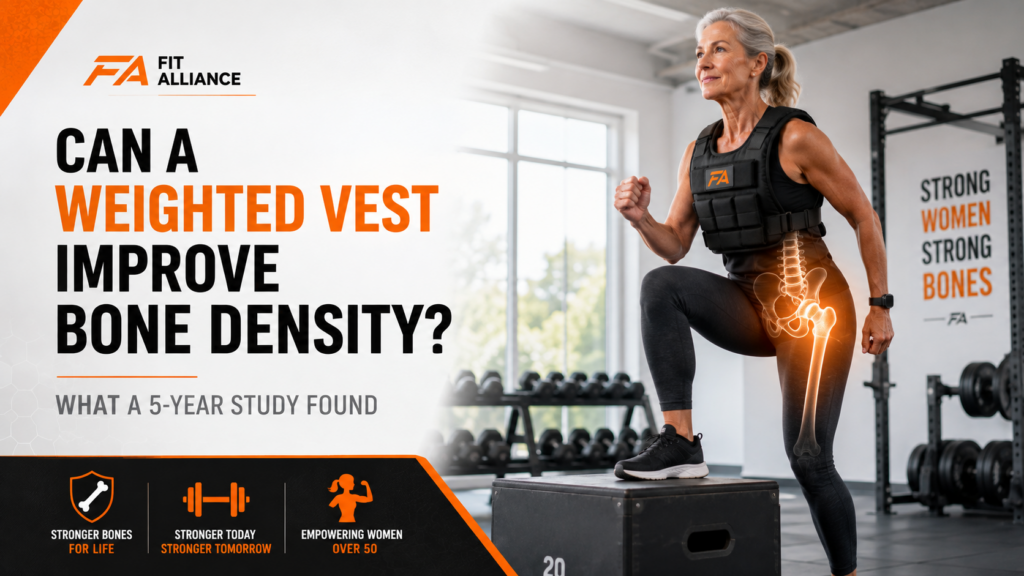
Can a Weighted Vest Help Improve Bone Density? What One 5-Year Study Found
Weighted vests have become popular among women who want to improve bone density, maintain strength, and protect their independence as they age.
But do they actually work?
The answer is, they may help when they are used correctly… especially when combined with impact training.
One important study on this topic is a 5-year study by Snow and colleagues, published in 2000, called Long-term Exercise Using Weighted Vests Prevents Hip Bone Loss in Postmenopausal Women. The study looked at whether weighted vest exercise combined with jumping could help prevent hip bone loss in postmenopausal women.
The results were encouraging, but the details matter. This was not a study where women simply wore a vest while walking around the house.
It was a structured program that combined weighted vest exercise + lower-body resistance work + jumping/impact training.
The biggest benefit was seen at the hip, especially the femoral neck… one of the most important fracture sites in osteoporosis.
Why the Femoral Neck Matters
The femoral neck is the narrow section of bone just below the ball of the hip joint. It connects the femoral head to the shaft of the thigh bone.
This area matters because femoral neck fractures are among the most serious fractures associated with osteoporosis. They can greatly affect mobility, independence, and long-term health.
The femoral neck is also unique from a training perspective.
Many bones respond well to resistance training because muscles pull directly on them (i.e. spine, wrists). When you lift weights, muscles create tension where they attach to bone, and that muscular pull creates a bone-building stimulus.
But the neck of the femur does not have major muscular attachments directly on it. The major hip muscles attach around nearby structures like the greater and lesser trochanters, while the femoral neck serves as the bridge between the head of the femur and the shaft.
That means the femoral neck may not get the same direct stimulus from resistance training as other bone regions. This is one reason impact may be especially important for the femoral neck.
When you land from a jump, step down, stomp, hop, or absorb force through the leg, the ground-reaction force travels upward:
foot → ankle → tibia → knee → femur → hip (lesser & gteater trochanter) → femoral neck
That impact exposes the femoral neck to compressive and bending forces that may help maintain or improve bone density and structure.
The Study: Snow et al., 2000
Snow and colleagues studied 18 postmenopausal women who had previously completed a 9-month exercise intervention and volunteered for long-term follow-up.
The women were divided into two groups:
- 9 women continued weighted vest plus jumping exercise
- 9 women served as active controls but did not participate in the weighted vest and jumping program
The control group was not inactive. They averaged about 5.7 hours per week of weight-bearing activity, but they were not doing the specific bone-loading protocol.
This distinction matters. The study was not comparing exercisers to sedentary women. It was comparing a specific weighted vest and impact program to general weight-bearing activity.
The Exercise Protocol
The 5-year follow-up continued the training approach from an earlier weighted vest study by Shaw and Snow. That earlier program used weighted vest lower-body exercise to improve fall-risk markers, strength, power, balance, and bone mass in postmenopausal women.
The exercise categories included functional lower-body movements that could be progressively loaded with the vest, such as:
- Sit-to-stands
- Squats
- Lunges
- Step-ups
- Calf raises
- Balance-oriented lower-body drills
- Jumping or impact-style loading as participants progressed
In the 5-year Snow et al. follow-up, the exercise group trained:
- 3 days per week
- Monday, Wednesday, and Friday
- 32 weeks per year
- For 5 years
The program included lower-body resistance exercises, weighted vest training, and jumping exercises. Participants were encouraged to use the vest while jumping, and the number of jumps per class increased after the first year.
Across the 5 years, the average training details were:
| Training variable | Study average |
| Compliance | 83.6% |
| Average jumps per session | 51.7 jumps |
| Average vest weight | 11.3 pounds |
| Frequency | 3 days/week |
| Duration | 5 years |
The key point is that the weighted vest was used as part of a structured lower-body and impact-training program, not as passive load during daily life.
In a Fit Alliance setting, comparable exercise categories would include:
- Weighted squats/sit-to-stands (vest, kettlebell, dumbbell, barbell)
- Step-ups
- Step-downs
- Stomps
- Marches with intennt
- Carefully progressed impact drills (including landings, jumps, skips/bounds, hops)
What Did They Measure?
The researchers measured bone mineral density, or BMD, at the proximal femur using DXA.
They looked at three important hip regions:
- Femoral neck
- Trochanter
- Total hip
These areas matter because hip fractures often occur around the femoral neck and trochanteric region. Total hip BMD is also an important predictor of hip fracture risk.
What Were the Results?
After 5 years, the women who did the weighted vest and jumping program maintained hip bone density much better than the control group.
| Bone site | Weighted vest + jumping group | Control group |
| Femoral neck | +1.54% | -4.43% |
| Trochanter | -0.24% | -3.43% |
| Total hip | -0.82% | -3.80% |
The biggest difference was at the femoral neck.
The exercise group gained a small amount of BMD at the femoral neck, while the control group lost more than 4%. The control group also lost more bone at the trochanter and total hip.
In simple terms:
The women who did weighted vest plus jumping maintained their hip bone density over 5 years, while the control group lost bone at every hip site measured.
Why This Study Matters
This study matters for four reasons.
First, it lasted 5 years. Bone changes slowly, so long-term follow-up gives us more useful information than a short exercise study.
Second, the results were strongest at the hip, especially the femoral neck, which is one of the most important areas for fracture prevention.
Third, adherence was high, with average compliance over 83%.
Fourth, the control group was still active. This suggests that general activity alone may not be enough. The type of loading matters.
What This Means for Women Over 50
The lesson from this study is not:
“Everyone should put on a heavy vest and start jumping.”
The better lesson is:
A weighted vest can be helpful when it is used as part of a progressive, supervised, bone-loading program.
For many women, the safest path is to build toward impact in stages:
- Build lower-body strength
- Improve balance and control
- Practice absorbing force
- Add low-level impact
- Progress to more challenging impact
- Add external load, such as a weighted vest, when appropriate
At Fit Alliance, that might start with sit-to-stands, squats, step-ups, carries, stomps, marches, and balance drills. Over time, some women may progress to weighted vest squats, weighted vest step-ups, step-down sticks, jump-and-stick drills, and other carefully dosed impact work.
The goal is to match the exercise to the person, not force everyone into the same program.
What This Study Does Not Prove
This study is encouraging, but it had limitations.
The sample size was small: only 18 women total. The women were also not randomly assigned into the long-term exercise or control groups. They self-selected whether to continue exercising.
The weight for resistance training, although progressive in nature, was also relatively low (avg. 11.3lb vest). results would have likely been better in total hip and trochanter using heavier weights.
So while this study is valuable, we should not oversell it as the complete solution.
It supports the idea that weighted vest plus impact training may help preserve hip bone density, but it does not prove that weighted vests alone are enough.
The Biggest Mistake People Make With Weighted Vests
The biggest mistake is assuming that simply wearing a vest automatically builds bone.
A weighted vest is just a tool.
It can make exercise more effective when it adds appropriate load to movements like squats, step-ups, lunges, marches, stomps, jumps, stair climbing, and loaded carries. But wearing a vest during casual walking or daily chores may not provide enough stimulus to significantly change bone density.
For bone density, the body needs a reason to adapt. That reason usually comes from progressive loading/impact.
Final Takeaway
The Snow et al. study showed that a 5-year weighted vest plus jumping program helped postmenopausal women maintain hip bone density.
The exercise group trained 3 days per week, averaged about 52 jumps per session, used an average vest weight of about 11 pounds, and maintained more than 83% compliance.
After 5 years, the weighted vest and jumping group had:
- +1.54% femoral neck BMD
- -0.24% trochanter BMD
- -0.82% total hip BMD
Meanwhile, the control group lost:
- -4.43% femoral neck BMD
- -3.43% trochanter BMD
- -3.80% total hip BMD
The most important message is this:
The femoral neck is a critical area for osteoporosis and hip fracture risk. Because it does not have major muscular attachments directly on it, it may not get the same direct stimulus from resistance training that other bone regions receive. Impact helps load the femoral neck in a way that strength training alone may not. Along with the impact, heavier resistance training loads may be necssary for optimal bone density improvements.
For women over 50, the best bone-density program is not just walking, not just lifting, and not just wearing a vest.
It is a thoughtful combination of:
- Progressive strength training
- Impact training when appropriate
- Balance work
- Power development
- Smart use of tools like weighted vests
- Nutrition interventions and sometimes hormone replacement therapy or medications if necessary
- Consistency over months and years
At Fit Alliance, our goal is to help women build the strength, balance, and confidence to safely expose their bones to the kinds of loading that help them stay strong for life.
Because working to improve bone density is really about staying active, capable, and independent for the long run.
Want to build stronger bones with a plan that is safe, progressive, and designed for women over 50?
Schedule a free first session at Fit Alliance and learn how strength training, balance work, and the right amount of impact can help you train for long-term independence.