The LIFTMOR study is one of the most frequently cited exercise studies in the osteoporosis world—and for good reason.
It challenged the long-standing belief that women with osteopenia or osteoporosis should avoid heavy lifting. Instead, researchers showed that appropriately supervised, progressively loaded high-intensity resistance and impact training can improve bone density, particularly at the spine.
The results were impressive.
But some important details are often lost when the study is summarized online.
The women were carefully screened before participating.
The sessions were highly supervised by exercise professionals.
Participants didn’t start with heavy weights. They were taught the exercises and progressed when they were ready.
The program was also overwhelmingly strength-focused. Even its warm-up involved relatively heavy resistance training.
And although LIFTMOR improved several measures associated with physical function and fall risk, it should not be mistaken for a complete fall-prevention program. Strength is important, but preventing falls also requires balance, coordination, reaction, and power—and developing those abilities requires additional training time.
Understanding these details gives us a much better picture of what LIFTMOR actually demonstrated and how we should apply it to the typical postmenopausal woman.
What Was the LIFTMOR Study?
The LIFTMOR trial included 101 postmenopausal women with low bone mass.
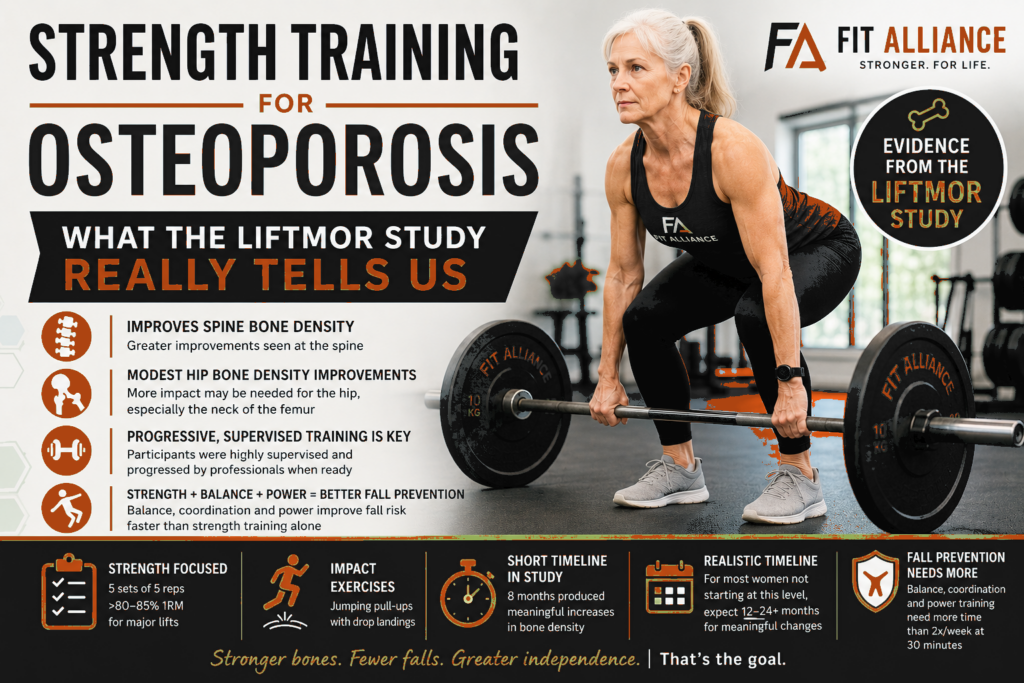
Participants in the exercise group completed an 8-month, twice-weekly, 30-minute supervised high-intensity resistance and impact training program.
The primary exercises were:
- Deadlift
- Back squat
- Overhead press
- Jumping chin-up with a drop landing
After the initial learning period, the three resistance exercises were performed for:
5 sets of 5 repetitions at greater than approximately 80–85% of one-repetition maximum.
That’s important.
This wasn’t light resistance training.
It wasn’t a circuit performed with small dumbbells.
And it wasn’t simply “movement for bone health.”
These were heavy strength-training parameters specifically designed to produce high mechanical forces through the skeleton.
The participants trained twice per week, but those two sessions contained a substantial amount of high-intensity work.
Even the LIFTMOR Warm-Up Was Strength-Focused
One detail that is particularly revealing is the warm-up.
The LIFTMOR exercise group did not begin each session with a duration of walking, stretching, balance exercises, or general mobility work.
As needed, participants performed up to two sets of deadlifts at approximately 50–70% of their one-repetition maximum as their warm-up.
Then they progressed into their working sets at greater than 80–85% 1RM.
In other words, even the warm-up was centered around strength.
A typical established LIFTMOR session therefore looked roughly like this:
- Up to 2 warm-up sets of deadlifts at 50–70% 1RM
- Deadlift: 5 × 5 at >80–85% 1RM
- Back squat: 5 × 5 at >80–85% 1RM
- Overhead press: 5 × 5 at >80–85% 1RM
- Jumping chin-ups with forceful drop landings
That’s a lot of work to fit into approximately 30 minutes.
The short duration sometimes gets emphasized when people talk about LIFTMOR—”You only need 30 minutes twice per week”—but that can be misleading without also explaining what those 30 minutes contained.
The sessions were short because they were extremely focused.
They were not low-intensity workouts.
They Didn’t Start There
There’s another essential detail.
The participants didn’t walk into the gym during week one and immediately start doing five sets of five heavy barbell squats and deadlifts.
During the first month, they performed bodyweight and low-load variations while learning the movement patterns.
Loads were gradually increased as technique and ability improved.
All participants were able to perform the four fundamental exercises within two months, after which the heavy resistance protocol continued.
This progression is arguably one of the most important lessons from the study.
LIFTMOR did not demonstrate:
“Everyone with osteoporosis should start lifting at 85% of their maximum.”
It demonstrated something much more useful:
Appropriately selected women with low bone density can progressively develop the ability to train at high intensities.
The Training Was Highly Supervised
Another detail often overlooked is just how much supervision these women received.
The sessions were performed in small groups with a maximum of eight participants per instructor, and the instructors were exercise scientists and physiotherapists.
That matters.
The participants weren’t handed a workout sheet and told to figure out heavy squats and deadlifts on their own.
Professionals were there to:
- Teach technique
- Observe movement
- Select appropriate loads
- Modify exercises
- Monitor tolerance
- Determine when resistance should increase
- Help participants progress safely
This is particularly important when we’re talking about women with osteopenia or osteoporosis.
The safety message from LIFTMOR should not simply be:
“Heavy lifting is safe with osteoporosis.”
A more accurate interpretation is:
High-intensity resistance training was well tolerated in carefully screened women when it was taught, supervised, and progressively introduced by qualified professionals.
That’s a very different statement.
The Results at the Spine Were Impressive
After only eight months, the high-intensity exercise group increased lumbar spine bone mineral density by approximately:
+2.9%
Meanwhile, the control group lost approximately:
−1.2%.
That is an impressive difference—especially considering how slowly bone changes.
Eight months is actually a very short time in the context of skeletal adaptation.
Bone remodeling occurs slowly. New bone has to be formed and subsequently mineralized before a measurable difference may appear on a DXA scan.
So a measurable improvement in spinal BMD after only eight months shouldn’t cause us to conclude that eight months is the normal timeline for everyone.
It should make us recognize how potent the LIFTMOR stimulus was.
These participants were:
lifting heavy, progressing their resistance, training consistently, receiving professional supervision, and performing impact exercise.
Most Women Starting Exercise Should Think in Years, Not Months
The typical postmenopausal woman beginning an exercise program may not be ready to train like a LIFTMOR participant.
She may have spent years without resistance training.
She may first need to improve:
- Basic strength
- Movement technique
- Tissue tolerance
- Balance
- Coordination
- Mobility
- Confidence
- Work capacity
She may need several months simply to build toward the loads used in LIFTMOR.
That’s what good training helps us achieve.
For someone starting substantially below the LIFTMOR level, it is generally more reasonable to think about bone-density improvement on a 12–24+ month timeline rather than expecting dramatic measurable changes within a few months.
That doesn’t mean everyone will improve their DXA in that timeframe, and it doesn’t mean nothing is happening before then.
Strength can increase within weeks.
Balance can improve.
Power can improve.
Muscle can increase.
Movement can become easier.
Fall risk factors can improve.
But measurable skeletal adaptation is a much slower process.
Be Skeptical of Promises of Fast Bone-Density Changes
This is one reason to be cautious with programs claiming that osteoporosis can be substantially improved through extremely short, or relatively easy workouts over a few weeks or months.
There’s nothing wrong with short exercise sessions.
There’s nothing wrong with starting with light resistance.
And a beginner may absolutely need lower-intensity exercise initially.
But we shouldn’t confuse an appropriate starting point with the stimulus eventually required to produce meaningful skeletal adaptation.
LIFTMOR used:
5 × 5 heavy deadlifts.
5 × 5 heavy squats.
5 × 5 heavy overhead presses.
Impact landings.
And the working resistance was greater than approximately 80–85% of maximum strength.
If a program promises rapid, meaningful increases in bone density while primarily using low-to-moderate resistance, minimal progressive overload, little or no impact, and extremely brief workouts, that claim deserves scrutiny.
The evidence from LIFTMOR does not support the idea that bone change is effortless.
The more useful message is:
You can start easy. You just shouldn’t expect to stay easy and create the same adaptation produced by high-intensity progressive training.
Bone needs an adequate stimulus.
Hip Bone Density Improved Much Less
The results at the femoral neck were much more modest.
The exercise group increased femoral-neck BMD by approximately:
+0.3%
while the control group lost approximately:
−1.9%.
Preventing that loss is meaningful.
But compare the magnitude:
Lumbar spine: +2.9%
Femoral neck: +0.3%
That’s a substantial difference.
It raises an important question:
Was there enough impact or other hip-specific loading in the program to maximize the femoral-neck response?
We can’t conclude from LIFTMOR alone that adding more impact would have produced a larger improvement.
But it is a reasonable question.
Heavy squats and deadlifts place substantial forces through the hips, but the femoral neck has no muscles attaching directly to it. Forces generated by muscle still travel through the hip, but impact creates a different type of skeletal stimulus.
Jumping, hopping, landing, and other impact activities create very rapid loading.
That high strain rate appears to be particularly important for bone adaptation.
So the LIFTMOR results may suggest that heavy resistance training is an excellent foundation—particularly for the spine—while more progressive impact may be desirable when the goal is maximizing adaptation at the hip and femoral neck.
But the LIFTMOR Impact Exercise Wasn’t a Beginner Exercise Either
LIFTMOR did include impact.
Participants performed a jumping chin-up followed by a drop landing.
They grasped an overhead bar, jumped as high as possible while pulling with their arms, and then dropped to the ground, attempting to land as heavily as was comfortably possible.
That’s not an insignificant movement.
Think about everything someone needs to perform it:
- Grip strength
- Shoulder mobility
- Upper-body strength
- Coordination
- Leg power
- Balance
- Confidence
- Landing ability
Many women beginning exercise later in life cannot perform a pull-up.
Many can’t comfortably hang from a bar.
Others have shoulder problems that make the position inappropriate.
And someone with poor balance or severe deconditioning may not initially be ready for a forceful landing.
Once again:
That doesn’t mean they can’t eventually perform impact exercise.
It means they may need a progression.
Another Major Limitation: Who Was Allowed Into LIFTMOR?
The women in LIFTMOR were carefully screened.
The researchers excluded potential participants for a number of medical and orthopedic reasons that could interfere with high-intensity exercise.
That means we shouldn’t assume the study population represents every woman who walks into a gym with osteoporosis.
In the real world, someone with low bone density may also have:
- Osteoarthritis
- Knee replacement
- Hip replacement
- Scoliosis
- Chronic back pain
- Shoulder limitations
- Poor balance
- Previous cancer treatment
- Significant muscle loss
- Years of inactivity
- Other medical conditions or physical limitations
Many of these women may not initially be appropriate candidates for the final LIFTMOR protocol.
But that doesn’t mean they shouldn’t progressively become stronger.
It simply means their starting point may be very different.
The Real Lesson From LIFTMOR Is Progression
Someone might begin with a sit-to-stand from a bench.
Then progress to a bodyweight squat.
Then a goblet squat.
Then progressively heavier resistance.
A deadlift might initially be performed with a light kettlebell from an elevated surface.
Later the load can increase.
Eventually, some people may be appropriate candidates for heavy barbell deadlifts.
Impact can be progressed the same way.
Someone may begin with movements that produce very little impact and gradually progress toward jumping, hopping, or landing as their strength, balance, and physical capacity improve.
The exact exercise is less important than providing an appropriate stimulus and progressively increasing it.
LIFTMOR Improved More Than Bone Density
It’s also important to give LIFTMOR credit for something beyond its bone results.
The intervention substantially improved strength and several measures of physical function.
Leg extensor strength improved by approximately 37%, and back extensor strength improved by approximately 36%.
Participants also improved their timed up-and-go, five-times sit-to-stand, functional reach, and vertical-jump performance compared with controls.
Those improvements matter because strength and physical function are related to fall risk.
A stronger person generally has a better chance of:
- Standing up from a chair
- Climbing stairs
- Controlling their body
- Recovering from small losses of balance
- Maintaining independence
So strength training absolutely belongs in a fall-prevention program.
But strength alone is not the same thing as training balance.
Strength Training Helps With Falls—But It Isn’t the Whole Solution
This is where we need to separate two related goals:
Building stronger bones
and
Preventing the fall that might break those bones.
Heavy strength training is extremely useful for bone, muscle, and functional capacity.
But the strongest evidence for preventing falls does not come from strength training alone.
Clinical guidelines and systematic reviews consistently show that programs emphasizing challenging balance and functional exercise are particularly effective at reducing falls.
A recent physical therapy clinical practice guideline summarizing the evidence found that balance and functional training reduced fall rates, while moderate-to-high-intensity strength training by itself did not show the same reduction. Programs combining more than three hours per week with balance and functional training were associated with approximately a 50% reduction in falls in the cited analysis.
The World Health Organization similarly recommends that older adults perform multicomponent activity emphasizing functional balance and strength on three or more days per week to improve function and help prevent falls.
That tells us something important about the LIFTMOR schedule.
Two 30-minute sessions equal roughly one hour of training per week.
That can be enough time to deliver a very focused high-intensity strength-and-bone stimulus.
It is much harder to fit a comprehensive fall-prevention program into that same hour while still doing all of the heavy lifting required by LIFTMOR.
What Else Does Fall Prevention Need?
A more complete fall-prevention program should also challenge the systems responsible for keeping us upright when something unexpected happens.
That can include:
Static balance
- Narrow stance
- Tandem stance
- Single-leg balance
Dynamic balance
- Stepping
- Turning
- Changing directions
- Moving around obstacles
Coordination
- Different foot patterns
- Agility work
- Contralateral movement
- Dual-task activities
Reactive balance
- Responding quickly to a loss of balance or perturbation
- Rapid stepping
- Changing direction unexpectedly
Power
- Standing quickly
- Fast step-ups/downs
- Rapid resistance exercises
- Stomping, jumping, bounding, hopping when appropriate
- Landing from elevated surfaces when appropriate
Strength answers the question:
“How much force can you produce?”
Power asks:
“How quickly can you produce it?”
That distinction matters if you trip.
You don’t have five seconds to slowly generate maximum force while you’re falling.
Your body may have only a fraction of a second to produce enough force to take a corrective step, reposition your center of mass, and prevent the fall.
Power training has been shown to improve balance in older adults, with improvements demonstrated within approximately 8–12 weeks in research using rapid resistance training.
Fall-Risk Factors Can Improve Faster Than Bone Density
This creates an important opportunity.
Bone density may require many months or years to change meaningfully.
But some of the physical abilities that help prevent a fall can improve considerably faster.
Balance, strength, coordination, gait performance, and power can begin improving within weeks to a few months of appropriate training.
For example, studies combining balance and strength training have demonstrated improvements in balance and muscle power after approximately 12 weeks, while power-training studies have reported balance improvements after only 8–12 weeks.
That doesn’t mean actual fall rates can always be proven to change within a few weeks—fall-prevention trials generally need longer follow-up to count enough falls.
But the modifiable physical risk factors associated with falling can improve much sooner than bone density.
That’s extremely important for someone with osteoporosis.
We shouldn’t spend the next two years waiting for the DXA scan to improve while ignoring the thing most likely to cause the fracture in the first place:
the fall.
Bone Strength and Fall Prevention Need Different Types of Training
This is why the ideal program for an older adult shouldn’t force us to choose between strength training and balance training.
We need both.
For bone density, we want enough:
Resistance.
Intensity.
Progressive overload.
Impact when appropriate.
For fall prevention, we additionally need enough:
Balance.
Coordination.
Agility.
Reaction.
Power.
Practice recovering from instability.
Trying to adequately train all of those qualities in only two 30-minute sessions per week is difficult—especially if most of those sessions are devoted to multiple sets of heavy squats, deadlifts, and presses with appropriate rest periods.
That’s why the most comprehensive programs may use formal strength sessions a few times per week while incorporating balance, coordination, power, and movement practice on additional days.
Or, multiple components can be included in one workout, if the session is 60 minutes instead of 20-30 minutes.
Not every training modality needs to be long.
But frequency and total exposure matter, particularly for balance.
What Should We Really Take Away From LIFTMOR?
LIFTMOR gave us an extremely important message:
Women with low bone density can become much stronger and can tolerate substantially more loading than previous generations of osteoporosis advice often suggested.
The exercise selection was effective.
The loading parameters were effective.
The progressive approach was effective.
And the lumbar spine results were particularly impressive.
But we shouldn’t remove those findings from the context of the study.
Participants were carefully selected.
Their sessions were highly supervised.
They were progressed by professionals when they demonstrated they were ready.
They eventually trained very hard.
Even their warm-up could involve deadlifts at 50–70% of maximum strength.
And the main resistance exercises were performed for five sets of five at greater than approximately 80–85% of maximum.
The women weren’t doing easy workouts and magically gaining bone.
They were training.
For someone beginning from a much lower fitness level, the journey toward that intensity may take months.
Meaningful changes in bone density may take 12–24 months or longer.
At the same time, we shouldn’t focus so heavily on improving the DXA score that we neglect fall prevention.
Strength training helps.
But a complete program should also devote sufficient time to balance, coordination, power, reactive movement, and other functional abilities.
Those qualities can improve much faster than bone density—and improving them may help prevent the fall that causes a fracture in the first place.
The Bigger Goal Isn’t Just Better Bone Density
The ultimate goal isn’t simply to increase a number on a DXA report.
It’s to build someone who is:
Stronger.
More powerful.
Better balanced.
More coordinated.
More resilient.
And less likely to fall.
At Fit Alliance, that’s why we don’t view bone-health exercise as a single workout or a quick fix.
We meet people where they are.
We progressively build strength.
We introduce appropriate impact.
We train balance and coordination.
We develop power.
And we give people enough time and practice to actually improve those abilities.
Because the goal isn’t to find the easiest or shortest program that can be marketed as “bone building.”
The goal is to progressively build a body that is both harder to break and less likely to fall in the first place.