Postmenopausal Bone Health: 5 Evidence-Based Ways Women Over 50 Can Improve Bone Density and Reduce Fracture Risk
Bone health after menopause becomes increasingly important because declining estrogen levels accelerate bone loss and increase fracture risk.
Many women do not realize they have osteopenia or osteoporosis until after a fall or fracture occurs. Unfortunately, osteoporosis is often called a “silent disease” because bone loss can happen for years without noticeable symptoms.
The good news is that research consistently shows there are effective ways to support bone density, improve balance, reduce fall risk, and strengthen the body after menopause.
The most effective osteoporosis prevention strategies usually combine:
- Strength training
- Impact exercise
- Balance training
- Proper nutrition
- Bone density screening
- Hormone replacement therapy (HRT) or medication when appropriate
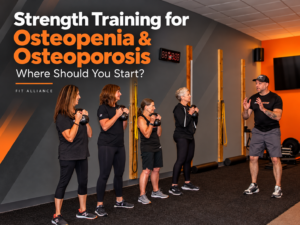
At Fit Alliance, helping adults 50+ improve strength, balance, mobility, and confidence is something we take seriously.
Our coaches completed the Better Bones and Balance certification through Oregon State University, one of the most respected evidence-based programs for fall prevention and bone health in older adults.
Oregon State University also happens to be my alma mater. I earned my degree there in Exercise and Sport Science and had the opportunity to learn from some of the same researchers whose work helped shape the principles used in the Better Bones and Balance program.
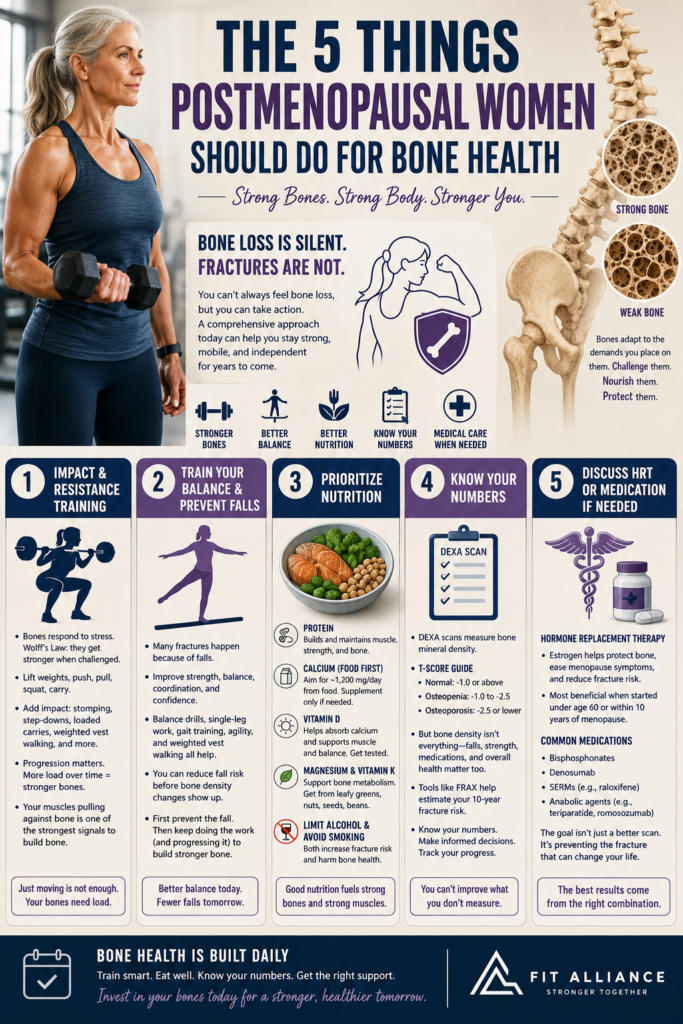
This article covers five important things postmenopausal women can do to help improve bone health, reduce fracture risk, and stay active long term.
1. Strength Training and Impact Exercise for Bone Density
One of the most effective ways to improve bone health after menopause is progressive resistance training.
Bones adapt to the demands placed on them. This principle is commonly referred to as Wolff’s Law, which states that bone remodels and becomes stronger when exposed to appropriate stress.
When bones are not challenged regularly, they become weaker over time.
Why Strength Training Matters for Osteoporosis Prevention
Research shows that resistance training can help maintain or improve bone mineral density, especially in the hips and spine.
These areas are among the most common fracture sites in postmenopausal women with osteoporosis.
Examples of beneficial resistance training exercises include:
- Squats
- Deadlifts
- Step-ups
- Carrying exercises
- Rows
- Pressing movements
- Resistance band exercises
- Weighted sit-to-stands
Progressive overload matters.
Simply moving is not always enough to stimulate bone growth. The body must be challenged appropriately and progressively over time.
Impact Training for Bone Health
Bones also respond well to impact exercise.
This does not mean every woman should immediately begin high-impact jumping programs. Impact training should be individualized based on joint health, mobility, balance, and fitness level.
For many women, impact training may begin with:
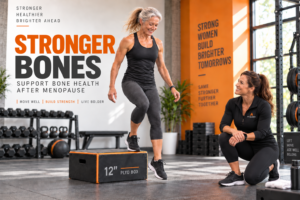
- Purposeful stomping
- Weighted vest walking
- Step-downs
- Loaded carries
- Brisk walking
- Stair climbing
Research has shown that postmenopausal women who walked with weighted vests were better able to maintain hip bone density compared to women walking without added load.
Studies also suggest that progressively increasing impact loading may improve bone density at the femoral neck, one of the most common hip fracture locations.
The key takeaway is simple:
Your bones need progressive loading to stay strong.
2. Balance Training and Fall Prevention for Older Adults
Many osteoporotic fractures happen because of falls.
This means improving balance, coordination, stability, and confidence is just as important as improving bone density itself.
One major finding from the Better Bones and Balance research at Oregon State University was that many women improved fall risk before major changes appeared on bone density scans.
Why Balance Training Matters
Balance training can help improve:
- Lower-body strength
- Reaction time
- Mobility
- Coordination
- Confidence with movement
- Stability during daily activities
Reducing fall risk is one of the fastest ways to reduce fracture risk.
Bone remodeling can take time, but improvements in balance and strength often happen much sooner.
Exercises That Improve Balance and Stability
Programs focused on osteoporosis prevention and healthy aging often include:
- Single-leg exercises
- Gait training
- Step patterns
- Agility drills
- Weighted vest walking
- Controlled impact progressions
- Stability exercises
For adults over 50, improving movement confidence can significantly improve quality of life.
The long-term goal is not just preventing falls.
The goal is preventing falls while simultaneously building stronger bones.
3. Nutrition for Bone Health After Menopause
Nutrition plays a major role in osteoporosis prevention and healthy aging.
Calcium matters, but bone health is about much more than calcium supplementation alone.
Bones are living tissue that are constantly being broken down and rebuilt.
After menopause, declining estrogen accelerates bone turnover and bone loss.
Proper nutrition helps support both bone remodeling and muscle mass, which are critical for fracture prevention.
Protein for Muscle and Bone Health
Protein is essential for:
- Maintaining muscle mass
- Supporting balance and strength
- Preserving lean tissue
- Supporting bone structure
Many older adults do not consume enough protein to support healthy aging.
Maintaining muscle is especially important because stronger muscles help reduce fall risk.
Calcium for Bone Density
Calcium remains one of the primary building blocks of bone.
The Bone Health & Osteoporosis Foundation generally recommends women over 50 consume approximately 1,200 mg of calcium daily.
Food sources are typically preferred before supplementation.
Examples of calcium-rich foods include:
- Greek yogurt
- Cottage cheese
- Sardines
- Salmon with bones
- Leafy greens
- Tofu
- Fortified dairy alternatives
Vitamin D and Bone Health
Vitamin D helps the body absorb calcium and also supports muscle function and balance.
Low vitamin D levels may increase fall risk and make it harder to maintain healthy bone density.
Because sunlight exposure is often limited in the Pacific Northwest, many adults benefit from checking vitamin D levels through bloodwork.
Magnesium and Vitamin K
Magnesium and vitamin K support bone metabolism and are best obtained through a diet rich in:
- Leafy greens
- Beans
- Nuts
- Seeds
- Vegetables
Lifestyle Factors That Affect Bone Health
Smoking and excessive alcohol consumption are both associated with poorer bone health and increased fracture risk.
Healthy bone nutrition generally includes:
- Adequate protein intake
- Sufficient calcium intake
- Optimized vitamin D levels
- Whole-food nutrition
- Limited alcohol intake
- Avoiding smoking
Nutrition alone is not enough to prevent osteoporosis.
However, it provides the raw materials needed for the body to respond to strength training, impact exercise, and recovery.
4. DEXA Scans, FRAX Scores, and Knowing Your Bone Density Numbers
One of the biggest problems with osteoporosis is that many people do not know they have it until after a fracture occurs.
A DEXA scan (dual-energy X-ray absorptiometry) is considered the gold standard for measuring bone mineral density.
DEXA scans help identify:
- Normal bone density
- Osteopenia
- Osteoporosis
Understanding T-Scores
DEXA scan results are commonly reported using a T-score.
- Normal bone density: -1.0 or above
- Osteopenia: between -1.0 and -2.5
- Osteoporosis: -2.5 or lower
Why Bone Density Is Only Part of the Picture
Bone density matters, but fracture risk depends on many additional factors, including:
- Balance and fall risk
- Muscle mass
- Prior fractures
- Family history
- Smoking history
- Medication use
- Menopause timing
- Long-term steroid use
- Overall health
This is why healthcare providers often use the FRAX tool alongside DEXA scans.
FRAX estimates a person’s 10-year fracture risk based on multiple health and lifestyle factors.
Research also suggests that bone quality matters in addition to bone quantity.
Two women can have similar DEXA scan scores but very different fracture risks depending on strength, balance, movement quality, and overall health.
Knowing your numbers can help guide:
- Exercise programming
- Nutrition planning
- Fall prevention strategies
- Discussions about HRT
- Decisions regarding osteoporosis medication
You cannot effectively measure progress if you never measure your starting point.
5. Hormone Replacement Therapy (HRT) and Osteoporosis Medications
Exercise, nutrition, and balance training are foundational for bone health.
For some women, additional medical support may also be appropriate.
Women with:
- Osteoporosis
- Rapid bone loss
- Previous fractures
- High FRAX scores
- Significant osteopenia
may benefit from discussing hormone replacement therapy or osteoporosis medication with their healthcare provider.
Hormone Replacement Therapy and Bone Health
Estrogen helps protect bone.
After menopause, estrogen levels decline rapidly, which accelerates bone loss.
Hormone replacement therapy may help:
- Slow bone loss
- Reduce fracture risk
- Improve menopause symptoms
- Support quality of life
HRT may be especially helpful for women:
- Under age 60
- Within 10 years of menopause
- Experiencing symptoms like hot flashes or sleep disruption
The Menopause Society notes that hormone therapy remains one of the most effective treatments for vasomotor symptoms while also helping reduce bone loss.
Common Osteoporosis Medications
Several medications are commonly used to reduce fracture risk in postmenopausal women.
Common bisphosphonate medications include:
- Alendronate
- Risedronate
- Zoledronic acid
- Ibandronate
Other medications may include:
- Denosumab
- SERMs such as raloxifene
- Anabolic medications like teriparatide or romosozumab
The goal of treatment is not simply improving a DEXA score.
The goal is preventing fractures that can significantly affect independence, mobility, and long-term health.
Medication should not be viewed as failure.
For many women, the best long-term outcomes come from combining:
- Progressive strength training
- Impact exercise
- Balance training
- Proper nutrition
- Hormone support when appropriate
- Medication when medically indicated
Final Thoughts on Postmenopausal Bone Health
Bone health after menopause requires a comprehensive approach.
Walking alone is usually not enough to maintain bone density.
Research consistently supports combining:
- Progressive resistance training
- Impact loading
- Balance work
- Proper nutrition
- Bone density screening
- Medical support when appropriate
At Fit Alliance, we specialize in helping adults 50+ build strength, improve balance, increase confidence, and stay active safely.
Our small group personal training programs are designed to meet women where they are while progressing exercise safely and appropriately.
If you are concerned about osteopenia, osteoporosis, balance, strength, or healthy aging, we would love to help.
Looking for Personal Training for Women Over 50 in Tigard?
Fit Alliance provides small group personal training, 1-1 personal training and nutrition coaching for adults 50+ in Tigard, Oregon.
We focus on:
- Strength training for older adults
- Balance and fall prevention
- Bone health and osteoporosis-friendly exercise
- Exercise after menopause
- Safe progressions for beginners
- Coaching in a supportive environment
If you would like to learn more, contact Fit Alliance today to schedule your first session.
To Your Success,
Jordon