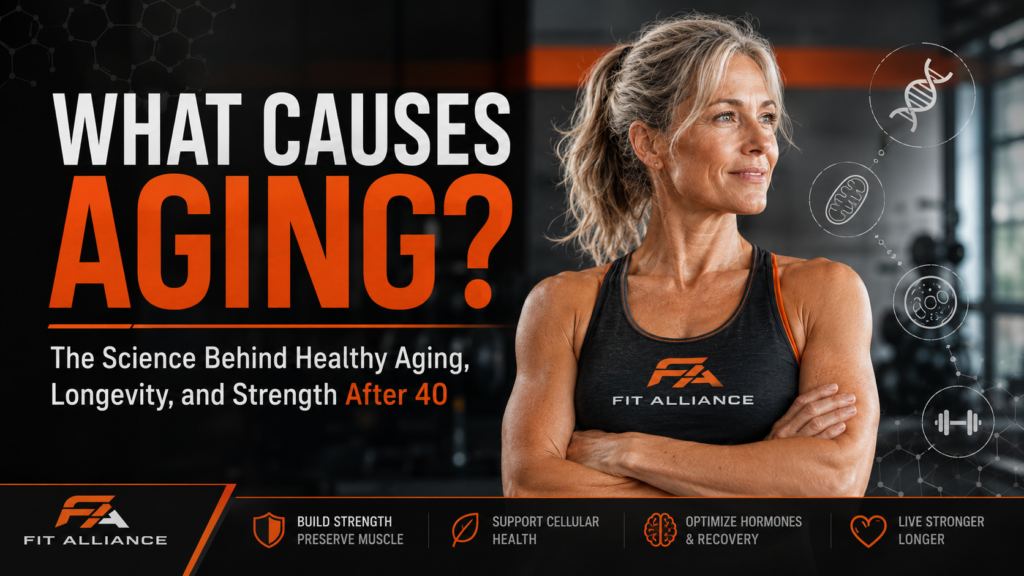
What Causes Aging?
Aging is often described as “getting older,” although biologically it is much more complex.
It is the gradual loss of the body’s ability to repair, recover, adapt, and maintain function. It affects cells, hormones, muscles, bones, the brain, metabolism, the immune system, and the way we respond to stress.
Research points to many overlapping causes, but aging develops through changes that affect cellular repair, energy production, inflammation, hormones, muscle, metabolism, sleep, social connection, environment, and physical resilience.
Some of these changes happen inside the body. Others come from lifetime exposure to things like smoking, pollution, inactivity, poor sleep, chronic stress, nutrition quality, social isolation, and other environmental factors.
Together, these influences shape how quickly we lose capacity and how well we maintain strength, independence, and quality of life.
Aging Starts at the Cellular Level
One of the most important research frameworks in aging science is called the “hallmarks of aging.”
The original hallmarks included DNA damage, telomere shortening, epigenetic changes, loss of protein quality control, altered nutrient sensing, mitochondrial dysfunction, cellular senescence, stem cell exhaustion, and altered communication between cells.
More recent research has expanded this model to include impaired autophagy, chronic inflammation, and changes in the gut microbiome.
In simpler terms, aging happens as the body becomes less efficient at protecting DNA, producing energy, clearing damaged material, controlling inflammation, maintaining tissue, and coordinating communication between systems.
These changes are deeply connected. DNA damage can increase inflammation. Mitochondrial dysfunction can reduce energy and increase cellular stress. Poor sleep can worsen metabolic function. Muscle loss can reduce resilience. Social isolation can influence inflammatory pathways.
Aging is best understood as a network of changes throughout the body.
DNA Damage, Telomeres, and Epigenetic Changes
Every day, your cells are exposed to stress from normal metabolism, inflammation, illness, environmental toxins, ultraviolet light, and other sources. The body has repair systems designed to protect DNA, although those systems become less reliable with age.
Telomeres are protective caps at the ends of chromosomes. They tend to shorten as cells divide and are also affected by stress and inflammation. When telomeres become too short, cells may lose their ability to divide and function properly.
Epigenetics refers to changes in how genes are turned on or off without changing the DNA code itself.
Think of DNA as the instruction manual and epigenetics as the system that decides which instructions get read. With age, this regulation becomes less precise. Genes involved in repair, inflammation, metabolism, and cell function may become less coordinated.
This is one reason lifestyle and environment matter. Exercise, nutrition, sleep, stress, toxins, and inflammation can all influence epigenetic patterns.
Mitochondria and Cellular Cleanup Become Less Efficient
Mitochondria are responsible for producing much of the energy your cells use.
As we age, mitochondrial function can decline. This affects energy production, recovery, metabolism, inflammation, and tissue repair. When mitochondria work less efficiently, people may notice lower stamina, slower recovery, reduced exercise tolerance, and more fatigue.
The body also has systems for clearing damaged proteins, worn-out cell parts, and cellular waste. Two important processes are proteostasis and autophagy.
Proteostasis refers to the body’s ability to properly make, fold, maintain, and clear proteins. Autophagy is the body’s cellular recycling process.
As these systems slow down, damaged proteins and dysfunctional cell parts can accumulate. This can interfere with normal cell function and contribute to age-related disease, especially in the brain, muscles, immune system, and metabolic tissues.
Progressive strength training, aerobic conditioning, sleep, and good nutrition are practical ways to support energy production, tissue repair, and cellular maintenance.
Senescent Cells, Immune Aging, and Chronic Inflammation
Cellular senescence happens when damaged cells stop dividing but do not fully die or get cleared away.
These cells are sometimes called “zombie cells” because they are no longer functioning normally, yet they continue sending out inflammatory signals that affect nearby tissues.
Over time, this can contribute to chronic low-grade inflammation, often called “inflammaging.”
The immune system also changes with age. It may become less effective at responding to new threats while becoming more prone to chronic background inflammation. This process is sometimes referred to as immunosenescence.
Inflammation is useful when the body is fighting infection or healing an injury. Ongoing, unresolved inflammation creates the bigger concern. Over time, chronic inflammation can affect joints, blood vessels, metabolism, brain health, muscle tissue, and recovery.
This helps explain why older adults may have a harder time recovering from illness, injury, surgery, or long periods of inactivity.
Hormone Changes, Especially Menopause, Influence Aging
For women, estrogen affects far more than reproductive health.
Estrogen plays a role in the urinary tract, heart and blood vessels, bones, breasts, skin, hair, pelvic muscles, mucous membranes, and brain.
This is why menopause can feel like such a major physical shift. As estrogen declines, women may experience changes in bone density, muscle mass, body composition, sleep, joint comfort, cardiovascular risk, urinary health, mood, and recovery.
Menopause is a major biological transition that can accelerate or reveal aging-related changes.
For women over 40, strength training, protein intake, balance work, cardiovascular conditioning, quality sleep, and medical screening become especially important.
Muscle Loss, Frailty, and Reduced Physical Reserve
One of the clearest signs of aging is the loss of muscle mass, strength, power, and physical function.
This is often called sarcopenia.
Sarcopenia affects far more than appearance. It can influence walking speed, balance, fall risk, independence, metabolism, blood sugar control, joint health, bone health, and recovery from setbacks.
Frailty is closely related. Frailty describes a state where the body has less reserve and becomes more vulnerable to stressors such as illness, surgery, falls, inactivity, or emotional strain.
This is where physical reserve matters.
Physical reserve is the extra capacity you have beyond what daily life requires. When reserve is higher, the body has more room to handle illness, injury, travel, stress, poor sleep, or a demanding day. When reserve is low, even a small setback can cause a major decline.
Two people can be the same age and respond completely differently to the same challenge. One may recover quickly after surgery, illness, or a fall. Another may lose strength, balance, confidence, and independence.
That difference is often related to strength, muscle mass, cardiovascular fitness, nutrition, sleep, medical status, mental health, and social support.
Resistance training is one of the most effective tools for preserving and rebuilding this reserve.
Metabolic Health, Nutrient Sensing, and Glycation
Metabolic health plays a major role in aging.
Insulin resistance, elevated blood sugar, excess visceral fat, high blood pressure, poor lipid profiles, and chronic inflammation can all contribute to faster biological aging.
One important process is glycation. Glycation happens when sugar molecules bind to proteins or fats and create advanced glycation end products, often called AGEs. These can contribute to tissue stiffness, blood vessel aging, inflammation, and oxidative stress.
The body also has nutrient-sensing pathways that monitor energy availability. These pathways influence repair, growth, inflammation, metabolism, and cellular cleanup.
Research on intermittent fasting suggests that periods of reduced energy intake may trigger metabolic switching, where the body shifts from using glucose toward fatty acids and ketones. This may influence pathways related to stress resistance, mitochondrial function, autophagy, and metabolic health.
Fasting can be useful for some people, although it should be matched to the individual.
For adults over 40, especially women trying to maintain muscle and bone, the biggest priorities are usually adequate protein, strength training, nutrient density, blood sugar control, sleep, and consistency. Aggressive fasting without enough protein or resistance training can work against muscle and bone goals.
The Gut Microbiome Is Part of the Aging Conversation
The gut microbiome affects digestion, immune function, inflammation, metabolism, and possibly brain health.
Recent aging research includes dysbiosis, or disruption of the gut microbiome, as one of the expanded hallmarks of aging.
Aging, medications, diet quality, illness, stress, sleep disruption, and inactivity can all affect the microbiome.
A practical nutrition approach that includes protein, plants, fiber, fermented foods when tolerated, and fewer ultra-processed foods may help support a healthier internal environment.
The Exposome: Your Environment Shapes How You Age
The exposome refers to the total collection of environmental exposures a person experiences across life.
This includes air pollution, smoking, alcohol, food quality, physical activity, chemical exposure, chronic stress, sleep patterns, socioeconomic conditions, early-life experiences, work environment, social environment, access to healthcare, neighborhood safety, and living conditions.
This matters because lifetime exposure plays a major role in how genes are expressed and how the body handles stress.
The exposome helps explain why two people with similar genetics may age very differently.
Sleep, Social Connection, and Brain Health Also Shape Aging
Sleep is when the body performs much of its repair work.
Poor sleep and disrupted circadian rhythms can affect hormones, appetite, blood sugar regulation, inflammation, immune function, brain health, and recovery.
Circadian rhythm is the body’s internal clock. It is influenced by light exposure, meal timing, sleep timing, movement, stress, and daily routine.
Social health also matters.
Loneliness and social isolation have been linked with inflammation, poorer health outcomes, and increased mortality risk. Research suggests inflammatory pathways may be one of the ways social disconnection affects physical health.
The brain is affected by many of these same factors: inflammation, blood flow, insulin resistance, sleep quality, social connection, physical activity, hormone changes, and cardiovascular health.
Exercise supports the brain by improving circulation, metabolic health, balance, coordination, strength, and possibly neuroplasticity. Social interaction and learning also help support cognitive reserve, which refers to the brain’s ability to maintain function despite age-related changes or disease burden.
A healthy aging plan should include both physical and cognitive challenge.
Aging Is Influenced, Not Fully Controlled
It is important to avoid oversimplifying aging.
Aging is shaped by genetics, early-life exposure, injury history, illness, access to care, hormones, stress, environment, and socioeconomic factors.
At the same time, many meaningful contributors are modifiable.
Strength training, aerobic conditioning, better nutrition, sleep, stress management, social connection, medical screening, and environmental awareness can all influence how aging shows up.
The aim is to build enough strength, resilience, and reserve to age better.
How Fit Alliance Helps
At Fit Alliance, we help adults over 40 build the strength, confidence, and physical reserve needed to age well.
Aging is complicated, although the practical strategy is straightforward: build more capacity before life demands it from you.
That is where expert coaching matters.
Many people know they should exercise, but they are not sure where to start. Others have been told to lift weights, improve balance, build bone density, or work on mobility, yet they are also dealing with chronic pain, joint replacements, scoliosis, osteoporosis, previous injuries, menopause-related changes, or years of feeling intimidated by the gym.
That gap is where Fit Alliance does its best work.
We help people bridge the space between the medical or therapeutic world and the type of exercise that truly improves strength, bone health, balance, muscle mass, confidence, and independence.
Our approach starts with assessment. Before adding intensity, we look at how someone moves, where they feel limited, what feels painful or restricted, and what level of challenge is appropriate. From there, we build a plan that progresses gradually and safely.
This matters because the research on healthy aging consistently points toward strength training, cardiovascular fitness, balance, nutrition, sleep, and consistency. Knowing what works is valuable. Knowing how to apply it to a real person with a real body, real limitations, and real goals is where coaching becomes essential.
A woman with osteoporosis, knee replacements, low back pain, or years away from exercise may need a different starting point than what is used in a research study. She can still get stronger with the right entry point, proper progressions, feedback, troubleshooting, and support along the way.
At Fit Alliance, we focus on building muscle, improving strength, supporting bone health, increasing balance, developing cardiovascular fitness, improving mobility, training around aches and limitations, building consistency, supporting nutrition habits, and creating a community where people feel comfortable showing up.
Our work centers on helping people become more capable.
For some clients, that means getting up from the floor with confidence. For others, it means hiking again, carrying groceries, traveling without fear, improving bone density, reducing fall risk, or feeling strong in their body for the first time in years.
Healthy aging requires more than information. It requires guidance, feedback, progression, troubleshooting, and support.
That is what we provide.
If you’re over 40 and live in the Portland area, Fit Alliance might just be the right place to help you build the physical reserve to keep doing the things you love with more strength, confidence, and independence.
The Practical Takeaway
Aging is caused by the interaction of internal biological changes and external lifetime exposures.
The major contributors include DNA damage, telomere shortening, epigenetic changes, mitochondrial decline, impaired cellular cleanup, chronic inflammation, immune aging, hormone changes, menopause-related changes, muscle loss, frailty, reduced physical resilience, metabolic dysfunction, gut microbiome changes, environmental exposures, sleep disruption, social isolation, and reduced physical reserve.
For adults over 40, the most practical strategy is to build capacity before it is urgently needed.
That means progressive strength training, cardiovascular fitness, balance work, adequate protein, fiber-rich nutrition, quality sleep, regular medical screening, stress management, and meaningful social connection.
Healthy aging is about maintaining the strength, independence, confidence, and resilience to keep living well.
To try out a FREE first session at Fit Alliance, just fill out the form on our website and a coach will be in contact with you right away.
References
- Johns Hopkins Medicine. Estrogen’s Effects on the Female Body.
- Kareem MA, et al. The Role of the Exposome in Aging and Age-Related Diseases. Journal of Pharmacy and Bioallied Sciences. 2025.
- Matthews T, et al. Social isolation, loneliness, and inflammation: A multi-cohort investigation.
- Smith KJ, Gavey S, Riddell NE, Kontari P, Victor C. The association between loneliness, social isolation and inflammation: A systematic review and meta-analysis. Neuroscience & Biobehavioral Reviews. 2020.
- Whitson HE, et al. Physical Resilience: Not Simply the Opposite of Frailty. Journal of the American Geriatrics Society. 2018.
- Yan R, et al. Optimal resistance training prescriptions to improve muscle strength, physical function, and muscle mass in older adults diagnosed with sarcopenia: A systematic review and meta-analysis. Aging Clinical and Experimental Research. 2025.
- Talar K, et al. Benefits of Resistance Training in Early and Late Stages of Frailty and Sarcopenia: A Systematic Review and Meta-Analysis of Randomized Controlled Studies. Journal of Clinical Medicine. 2021.
- de Cabo R, Mattson MP. Effects of Intermittent Fasting on Health, Aging, and Disease. New England Journal of Medicine. 2019.
- López-Otín C, Blasco MA, Partridge L, Serrano M, Kroemer G. Hallmarks of Aging: An Expanding Universe. Cell. 2023.
- López-Otín C, Blasco MA, Partridge L, Serrano M, Kroemer G. The Hallmarks of Aging. Cell. 2013.